
Access Denied
IMPORTANT! If you’re a store owner, please make sure you have Customer accounts enabled in your Store Admin, as you have customer based locks set up with EasyLockdown app. Enable Customer Accounts

ONE FAMILY. MANY ISLANDS — THE STORY BEHIND THE WORDS
Posté par Nesian Kulture
on
When Susan, co-founder of Nesian Kulture, first spoke the words “One Family. Many Islands.” it wasn’t a catchy slogan.
It was her life story finding its voice.
Susan is Tongan, born in New Zealand, raised across two worlds. She grew up at a time when Pacific Islanders weren’t always seen or understood. When her family moved to Australia in 1988, everything changed. Suddenly, she and her siblings were the only Islanders in their school.
They were noticed when sports carnivals came around — strong, fast, useful.
But outside of that?
No one asked to sit with them.
No one asked to be a real friend.
It was a lonely kind of visibility — seen for your talent, but not for your identity.
But home… home was her refuge.
Her parents worked hard, long hours to provide, but when holidays came, they made sure their children never lost where they came from. Her mum kept culture alive in everything she did. Even far from Tonga, Tongan life continued faithfully in Australia.
Susan remembers:
-
going to Tongan weddings,
-
pāpi (baptisms),
-
birthdays,
-
putu (funerals),
-
and every community event her mum could find.
Culture wasn’t something they visited — it was something they carried.
And sometimes, Susan and her younger sister Taiana would perform.
Even though they were Tongan, they were taught Cook Island dancing by Cook Island family friends — and Susan absolutely fell in love with it.
The drums.
The grace.
The power.
The story told through movement.
It never bored her — because it carried the same spirit she felt in her own culture.
Different islands, same heartbeat.
Those moments shaped her understanding of the Pacific in a way school never could:
Culture doesn’t die when you leave the islands.
It lives in the gatherings.
It lives in the people.
It lives in the way Islanders uplift each other, across borders and backgrounds.
So years later, when Susan married Feeros — a Lebanese man raised with values almost identical to Pacific culture — she realised something even deeper:
Respect is universal.
Family is universal.
Honour is universal.
And the first time she said “One Family. Many Islands.”, it came from that truth, not a marketing idea.
Different Islands, Same Way of Life
Every island has its own language, dances, and traditions — but the foundation is the same:
-
Respect for elders
-
Respect for family
-
Respect for land and sea
-
Respect for the name you carry
Whether you’re from Samoa, Tonga, Fiji, Vanuatu, Kiribati or the Cook Islands — the way you greet, gather, share food, and honour others comes from the same cultural DNA.
Our differences aren’t barriers.
They’re colours.
And when woven together, they create one strong mat.
That is what Susan saw.
That is what she lived.
That is why the words came out of her spirit first, not her mouth.
Wearing the Message
When our people wear Nesian Kulture, they’re not just repping one island — they’re repping all of us.
We’ve had customers tell us:
“I’m Fijian, but when I wear the NK tee with Polynesian and Melanesian flags, I feel like I’m honouring my cousins too.”
“It reminds me that even though we live oceans apart, our values are the same.”
That is the heart of this movement.
You can stand proudly in your own culture
while honouring the others.
Why It Matters Today
The world often sees Pacific Islanders as small — separated into dots on a map.
But we know better.
Because when Islanders stand together,
we’re not small at all.
We’re a family.
This tagline isn’t about clothes.
It’s about identity.
It’s about reminding every Pacific Islander — young or old, local or overseas — that they belong to something bigger than themselves.
Our Promise
Nesian Kulture will always stand by these words:
We may be different in culture.
But we are the same in way of life.
And that way of life is built on respect.
Because at the end of the day —
We are One Family. Many Islands.
This movement began with Susan and Feeros’ family,
but it continues with yours.
Wear the message.
Share the honour.
Carry the respect.
Related Posts

Bougainville Belongs Here
At Nesian Kulture, we include the Bougainville flag because we honour identity beyond politics. Bougainville may not be an independent...
En savoir plus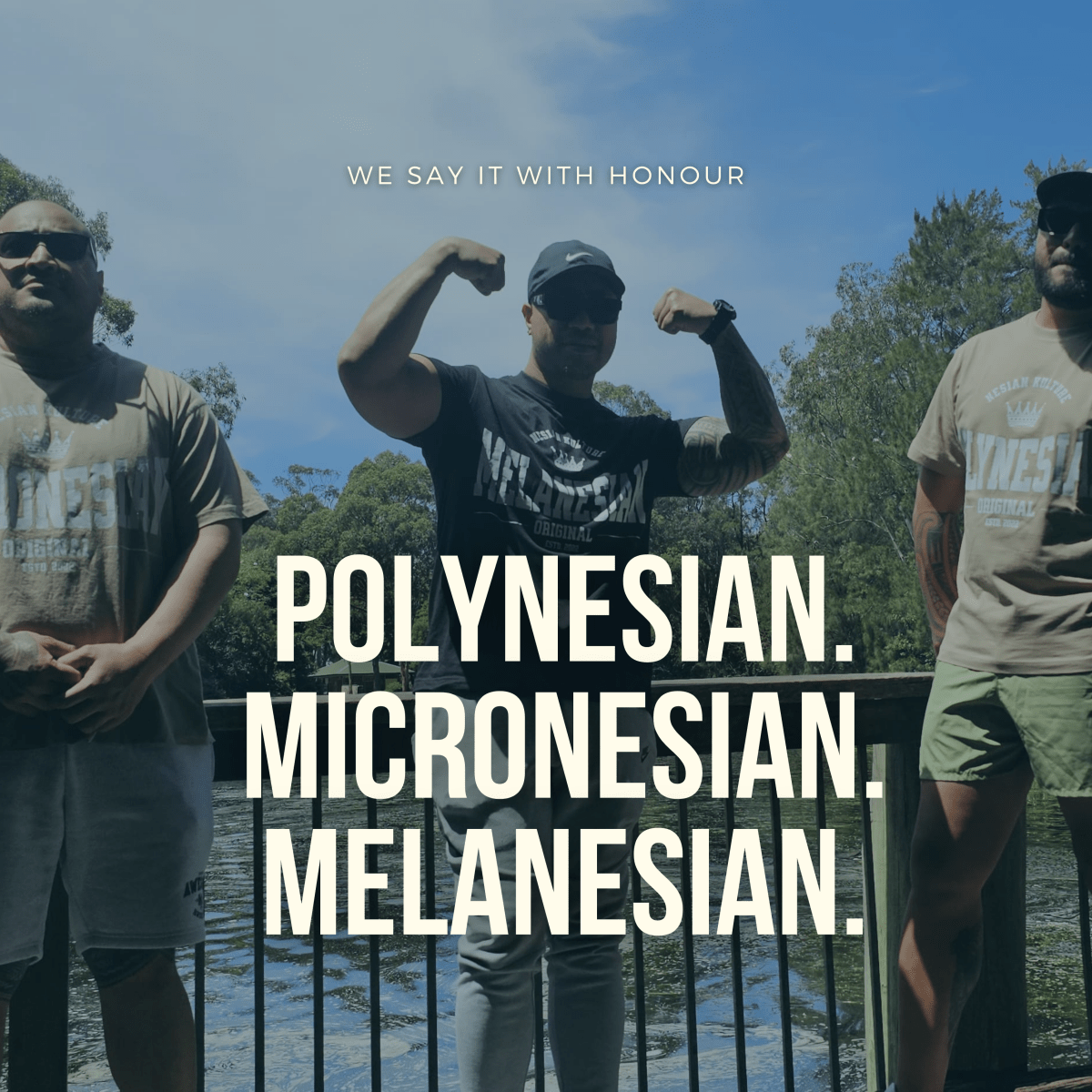
We Still Say Polynesian, Micronesian & Melanesian — And We Say It With Honour
Some say we shouldn’t use names like Polynesian, Micronesian, or Melanesian. At Nesian Kulture, we believe those names no longer...
En savoir plusInvalid password
Enter